“12 hours of day—12 hours of night—that’s how autumn begins,” rhymes the star poet Roland Müller cheerfully. And after what felt like an endless summer and eventful weeks at the Star Park, September is now quietly arriving: The days are getting shorter, and twilight sets in earlier. Fall is approaching—and this is gradually becoming evident in the night sky as well. When the Earth reaches the fallal equinox on September 23 at 1 a.m. on its journey around the Sun, day and night will be nearly equal in length even at our latitudes.
The "She Can't Help It" Venus, the Moon, and the Planets
Shortly after sunset, it’s worth looking toward the southwest. Our innermost neighboring planet shines brightly in the twilight, living up to its nickname as the “Evening Star.” It will reach its peak brightness as the highlight of the evening sky by September 19. After that, it will pass between the Earth and the Sun—hidden from our view—and reappear in November as the Morning Star before sunrise. While you can spend any clear evening admiring Venus, you can also observe its interplay with our Moon: September begins with a new moon, and on the evening of September 14—after the new moon—the wafer-thin crescent Moon joins Venus. After that, the two move apart again. When the full moon is the brightest light of the night on September 26, it becomes clear why one of September’s historical names is “Harvest Moon.” It will then be positioned just to the right and slightly above Saturn. Jupiter and Mars, on the other hand, graciously make themselves visible to early risers in the morning hours.
The Swan in the Middle of the Milky Way, with a Star for Science
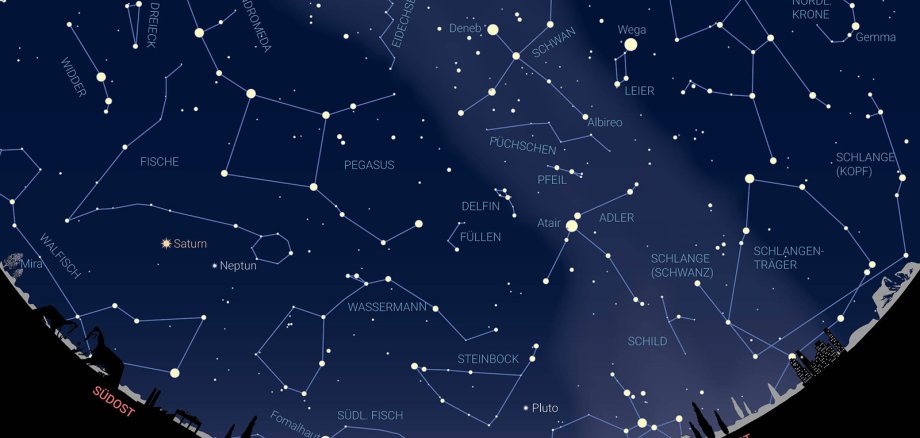
The fact that darkness falls earlier has the advantage that you can now view the summer Milky Way at more convenient times. In all its splendor, it appears as a silvery, shimmering band that stretches across the sky from the northeast to the southeast. High in the sky—as if flying across the heavens alongside the Milky Way—stands Zeus, the father of the gods, in the form of a swan. To its right and left are the other two summer constellations, Lyra and Aquila. The Swan, Cygnus in Latin, is one of the few constellations whose outline matches its name: its distinctive cross-like shape makes it a beautiful and easily recognizable constellation. The brightest star, Deneb, forms the tail, while the second-brightest star, Albireo, forms the head. Sadr shines as the body star, while the wings spread out to the right and left of it.
However, 61 Cygni is considered one of the most historically significant stars in the sky. It was the first star used to measure the distance to a star. In 1838, the Minden-born astronomer Friedrich Wilhelm Bessel used this star to demonstrate that the Earth does indeed orbit the Sun. Bessel measured the star’s minute back-and-forth wobble—caused by the Earth’s motion around the Sun—against the background of much more distant objects. The new model of the universe, calculated by Nicolaus Copernicus and supported by Galileo’s observations, received decisive confirmation through Bessel’s precise measurements. On dark nights and in places without light pollution, you can even see this star—a landmark in the history of science—with the naked eye.
All Four Seasons in the Sky
The early-summer constellations Bootes—with its brightest star, Arcturus—the Northern Crown, and Hercules have already shifted toward the west. The Pegasus Square represents autumn in the east. The Big Dipper stands near the northern horizon, far below the North Star. From the northeast, Cassiopeia, Perseus, and Andromeda are approaching, along with the first winter stars. Special attention should now once again be paid to the southern horizon: there, at the end of the Milky Way, Sagittarius sparkles in all its splendor. And if we could see beyond the clouds of gas and dust, we would reach the center of our galaxy, 26,000 light-years away—with an unimaginable “mass” of 4 million solar masses, it forms the black hole around which all the stars in the sky orbit.
A Look Back at the Star Park Weeks: Turn Signs into Habits!
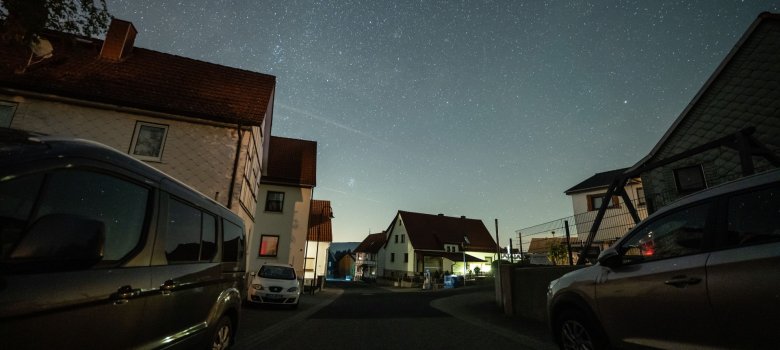
The program of events during the Star Park Weeks in August was more extensive than ever before. And many visitors and locals actively took part in the various activities. The most important event for the goals and mission of the Rhön Star Park was the “Lights Out” campaign around the second weekend in August. For the sixth time, numerous municipalities left public lighting completely turned off for the entire weekend. And this year, too, it’s clear just how unspectacular the campaign actually is—it’s simple to implement and it works. This once again raises the question of compromise: Why not—as some Rhön municipalities have been doing for years—turn off public lighting entirely during the late hours—the heart of the night—all year round? This would not only prevent light from being scattered by dust particles into outdoor areas and protected zones—but would also save valuable energy, effectively supporting the diurnal and nocturnal creatures that bring joy to our gardens, replace light pollution with a starry sky, and we’d be surprised to discover that it’s rarely truly dark and just how well we can see at night.