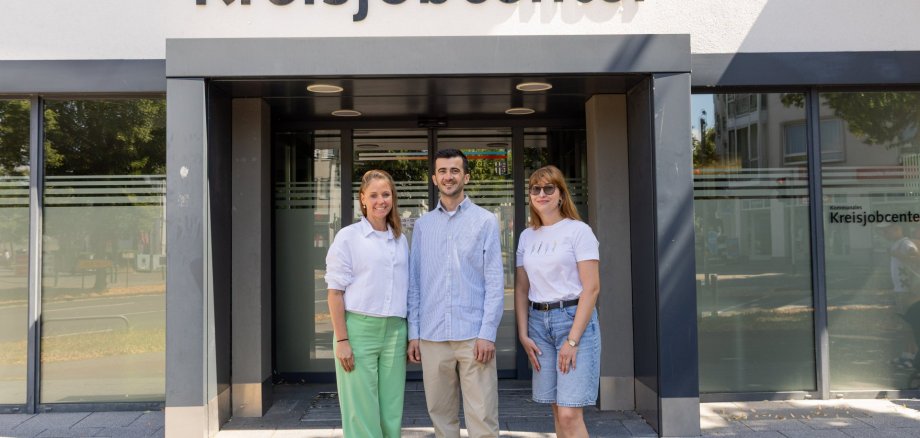
Saidolim Sharofi is 33 years old, is originally from Tajikistan, and speaks four languages fluently: Persian, Russian, German, and English. A trained German teacher, he has been living permanently in Germany only since 2021. Even while studying Intercultural Communication at Fulda University of Applied Sciences, he volunteered with the organization “Welcome In e.V.” Since 2024, he has been working full-time as a labor market advisor supporting language courses at the district job center. His role, funded through the State of Hesse’s training and qualification budget, is to support participants in Level B1 language courses (see info box) in developing career prospects and planning their first steps into the German job market. “This work is extremely valuable to the District Job Center because, as an early-stage bridge between language acquisition and entering the workforce, it relies on voluntary participation and offers low-threshold guidance before participants transition into the District Job Center’s regular support program,” emphasizes Verena Malkmus, department head in the Integration Division.
More Than Just a Job Placement Service
“I give a presentation to introduce myself and the services I offer in the language courses. Anyone who’s interested can then book an individual or group consultation,” Sharofi explains. He provides advice—regardless of the specific legal field—on topics such as job searches and applications, vocational training, and internships. If requested, he helps draft resumes, identifies potential opportunities, and searches for jobs near where people live. He also works as an interpreter at local job fairs. But his commitment goes far beyond job searching. “From my own experience, I know how valuable social networks are for learning a language and, consequently, for successful integration,” says Saidolim Sharofi. “That’s why I help them build these networks, for example by finding out about local clubs. Whether it’s volunteer work or sports—anything is better than staying at home.” In addition to language acquisition, the biggest hurdles for immigrants are childcare and mobility. The recognition of foreign driver’s licenses and balancing work and family life are therefore also part of the counseling. “Many simply have to take the plunge,” says Sharofi.
Taking the Plunge
Olha Kovac also took the plunge when she fled the war in Ukraine in 2022 with her son Tima, who is now ten years old. Now 34, she left behind the rest of her family and her former life as an elementary school teacher in Odessa. Through a church-sponsored refugee aid project, she ended up in Thalau—where she was warmly welcomed. While Tima has learned German at lightning speed through school and local clubs, Olha is finding it much more difficult. “Reading comes more easily to me than understanding the spoken language,” she says. She met Mr. Sharofi at the end of an integration course. He encouraged her to apply for recognition of her Ukrainian college degree to improve her chances of finding a job. With his support, she submitted an application to the Hessian Teachers’ Academy for recognition of her Ukrainian teaching degree—and was successful. “Ms. Kovac’s subjects, grades, and professional experience met more than 50 percent of the requirements,” reports the job coach. “Our goal was to have her recognized as an educational professional so she could work as a preschool teacher, for example.” But things turned out even better: “She is now officially authorized to teach math and general studies for grades one through four, as well as Ukrainian for grades one through nine, in Hesse.” However, her language skills are not yet sufficient to actually work as a teacher in a school. “C1 is mandatory,” Sharofi emphasizes. This makes it all the more gratifying that Thalau Elementary School had already given Olha a chance—as a staff member in the after-school program. With this job at the school, she has taken a big step forward, because her salary allows her to provide for herself and her son and means she is not dependent on social assistance. Her next goal is to get her driver’s license, and at the same time she wants to work on her German skills, because the school is definitely interested in hiring her as a teacher as well, Olha reports. Meanwhile, the job coach’s dedication is also bearing fruit elsewhere: inspired by this positive experience, she has already motivated three other Ukrainian women to seek recognition of their degrees.
Info: Language Courses
In Europe, language proficiency is divided into six levels according to the Common European Framework of Reference for Languages (CEFR):
A1 – Beginner: Understands and uses simple words and phrases in everyday situations.
A2 – Basic proficiency: Can communicate in simple, routine situations and carry on short conversations.
B1 – Advanced language use: Can handle most everyday situations independently and discuss experiences, plans, and opinions.
B2 – Independent language use: Understands even more complex texts and can converse fluently and largely spontaneously.
C1 – Proficient language skills: Uses the language confidently and flexibly in professional and academic contexts, as well as in demanding conversations.
C2 – Near-native level: Understands almost everything effortlessly and can express themselves precisely and with nuance.