Broadband Expansion in the Fulda District
The Fulda district is launching the largest infrastructure project in its history: the comprehensive rollout of a high-performance fiber-optic network for private households, businesses, and public institutions. The goal is to sustainably improve digital connectivity and provide all residents with access to a modern, stable, and future-proof Internet connection. The expansion will extend all the way into buildings (FTTH) and is funded in accordance with federal guidelines. This will make it possible to connect areas in particular that would not be included—or would only be included much later—under a purely market-driven expansion. The gigabit expansion, funded by the federal government, the state of Hesse, and the Fulda district, complements the market-driven expansion carried out by telecommunications companies.
Overall, the project is divided into eleven expansion clusters, which will be implemented one after another. The expansion began in the fourth quarter of 2025 with the first cluster. A new expansion cluster begins every three months, ensuring continuous and predictable progress. A construction period of approximately twelve months is planned for each cluster. Due to statutory funding regulations, residential properties with a cable TV connection (HFC network) are generally excluded from the subsidized expansion.
The subsidized fiber-optic expansion project involves several hundred kilometers of civil engineering work, the construction of new distribution points, and the installation of thousands of kilometers of fiber-optic cables. The project is being implemented in close cooperation with the contracted network operator, Telekom Deutschland GmbH, and the participating construction companies. The expansion plan covers approximately 20,500 addresses.
For residents, the project represents a significant improvement in the digital infrastructure that supports their daily lives. In order for a building to be connected, the owner’s consent is required. Property owners will receive all relevant information and documents in a timely manner. The connection itself is provided free of charge as part of the grant-funded project.
Development Areas
The following phases of the fiber-optic network expansion are planned:
- City of Fulda (southern districts) / Neuhof-Giesel
- Ebersburg / Gersfeld-Hettenhausen
- City of Fulda (northern neighborhoods)
- Poppenhausen / Gersfeld / Ehrenberg
- Hilders / Tann
- Nüsttal (Morles, Hofbach, and Mittelaschenbach) / Hofbieber / Dipperz
- Nüsttal (remaining portion) / Hünfeld / Burghaun-Steinbach
- Neuhof (Rommerz, Dorfborn, Tiefengruben) / Kalbach (Niederkalbach and Mittelkalbach) / Flieden
- Eiterfeld / Rasdorf / Burghaun (Langenschwarz, Schlotzau, Großenmoor)
- Neuhof-Hauswurz / Flieden (Flieden, Rückers) / Kalbach (Oberkalbach, Uttrichshausen)
- Bad Salzschlirf / Großenlüder / Hosenfeld
Note on the division of areas:
The expansion areas are not based on municipal or city boundaries, but on local network codes. As a result, a municipality may be divided into up to three expansion areas.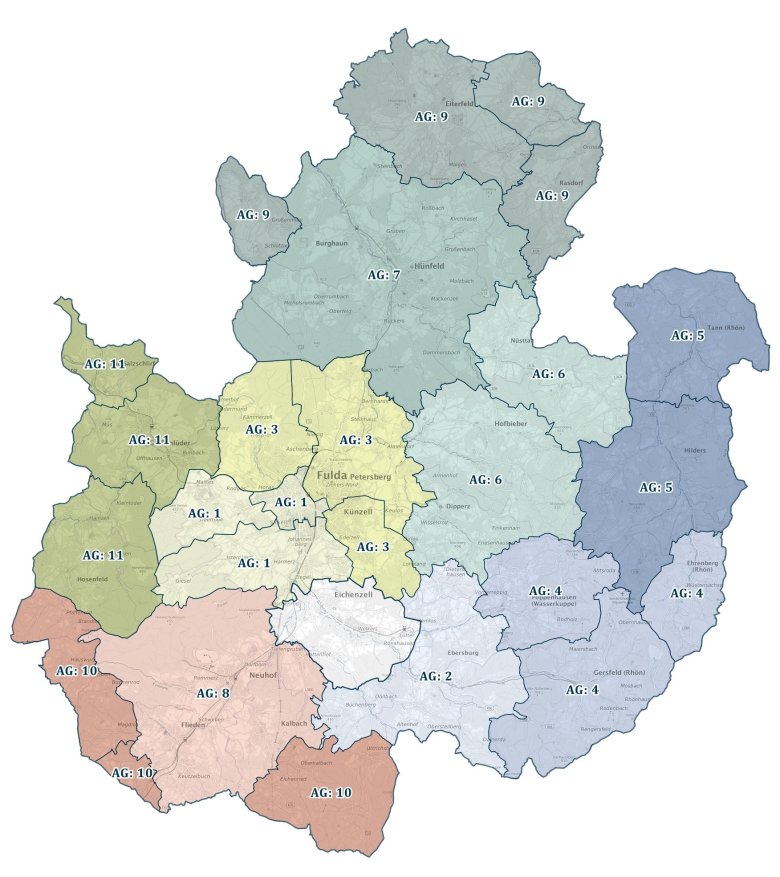 © Fulda District
Scheduling for the Municipalities
Cluster Description Planned Start Date for Marketing Planned Start Date for Civil Engineering Work 1 Fulda (southern neighborhoods), Neuhof-Giesel September 2025 December 2025 2 Ebersburg, Gersfeld-Hettenhausen January 2026 April 2026 3 Fulda (northern neighborhoods) April 2026 July 2026 4 Poppenhausen, Gersfeld, Ehrenberg July 2026 October 2026 5 Hilders, Tann October 2026 January 2027 6 Nüsttal (Morles, Hofbach, and Mittelaschenbach), Hofbieber, Dipperz January 2027 April 2027 7 Nüsttal (remaining portion), Hünfeld, Burghaun-Steinbach April 2027 July 2027 8 Neuhof (Rommerz, Dorfborn, Tiefengruben), Klabach (Niederkalbach and Mittelkalbach), Flieden July 2027 October 2027 9 Eiterfeld, Rasdorf, Burghaun (Langenschwarz, Schlotzau, Großenmoor) October 2027 January 2028 10 Neuhof-Hauswurz, Flieden (Flieden, Rückers), Kalbach (Oberkalbach, Uttrichshausen) January 2028 April 2028 11 Bad Salzschlirf, Großenlüder, Hosenfeld April 2028 July 2028 Note: Due to legal funding regulations, residential properties with a cable TV connection (HFC network) are generally excluded from the subsidized expansion.
Completed Projects in the Fulda District
“White Spot Funding” (2nd Federal Funding Call)
In the Fulda district, approximately 150 km of civil engineering work, 245 km of conduit, and 572 km of fiber-optic cable were installed as part of the “White Spot Funding” initiative. As a result, nearly all households now have Internet speeds of at least 30 Mbit/s, 98% of households have speeds over 50 Mbit/s, and fiber-optic connections offer speeds of up to 1 Gbit/s. All schools in the Fulda district received a fiber-optic connection and now have internet speeds of up to 1 Gbit/s. Telekom also expanded its network on its own initiative and further increased bandwidths. The subsidized expansion covered 13 clusters and was completed in 2021.“White-Spot Funding” (6th Federal Funding Call)
As part of the 6th funding call, starting in the second quarter of 2021, primarily isolated settlements and smaller hamlets in the Fulda district were equipped with FTTH fiber-optic connections. The connected households and businesses can use bandwidths of up to 1 Gbit/s.Connecting Hard-to-Access Isolated Locations
In July 2022, the contract for the project “Connecting Hard-to-Access Isolated Locations (SEE) in the Fulda District” was awarded. After prioritizing the project based on environmental and economic considerations, implementation began first in Hofbieber-Fohlenweide, Gersfeld – Haus am Roten Moor, and two locations in Eiterfeld. Additional work was carried out in the rural areas of the municipalities of Hünfeld, Burghaun, and Petersberg. The work—in particular, the installation of empty conduits into the buildings and the creation of so-called “Homes Passed Plus” connections—was carried out according to schedule and completed in 2023. All individual communities now have gigabit conduit infrastructure, which, as part of the “Grey Spots Funding” initiative, has been equipped with active components and connected to the network. The project was funded by the State of Hesse and the federal government as part of the Joint Task “Improvement of Agricultural Structures and Coastal Protection” (GAK).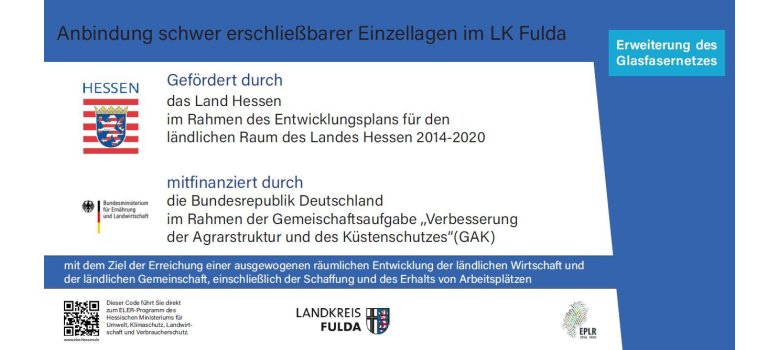
Partners