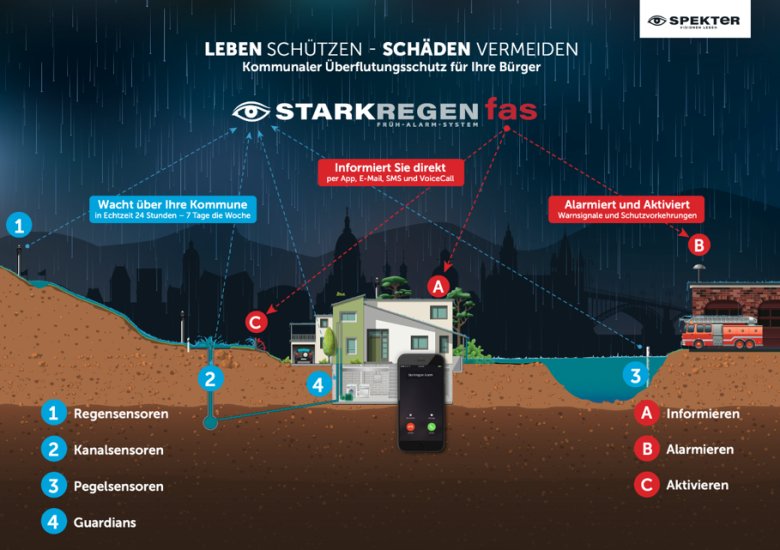
Heavy Rain Early Warning System
Due to rising temperatures, heavy rainfall and flooding are becoming increasingly common in the Fulda district as well.
The goal: The Fulda district aims to be able to issue early warnings to residents, emergency responders, and government agencies in order to protect lives and minimize damage. To this end, a supraregional early-warning system for heavy rain was developed and implemented for the first time in Germany.
The solution: In collaboration with project partners and all municipalities, the district developed an alert system in 2024. To this end, more than 180 sensors were installed throughout the district, and an analysis system—including a mobile app—was developed. Artificial intelligence and state-of-the-art wireless and cloud technology enable the detection of heavy rain risks and the immediate issuance of alerts in the event of an imminent danger.
The Hessian Ministry of Digital Affairs provided 828,000 euros in funding for the project.
In September 2026, the system was awarded the federal "Blauer Kompass" prize.
The Need for an Alarm System
Rising temperatures are leading to more rain throughout Germany. If the temperature rises by 1°C, the air can hold about 7% more water. This water is increasingly being released in the form of thunderstorms and heavy rain events. In 2018, the Fulda district was hit by such extreme weather conditions.
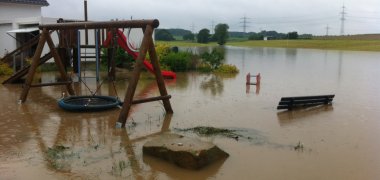 © Jutta SchäferFlooding following a heavy rainstorm in Dirlos.
Thanks to digitalization, an alarm system was introduced at the end of April 2024 for all 23 cities and municipalities in the Fulda district.
How It Works
About 200 sensors were installed along waterways, on rooftops, and in sewer systems. These sensors provide a comprehensive set of data tailored to regional needs and rural areas.
 © Sebastian MannertHesse's Minister of Digital Affairs, Prof. Dr. Kristina Sinemus, with the water and precipitation sensors.
The system measures in real time how hard it is raining, how high the water level is, and how fast it is draining. The data collected is transmitted to the cloud, where it is analyzed by AI algorithms and merged with data from weather services.
If necessary, the system automatically alerts citizens, emergency responders, and government agencies via text message, email, or phone call. You’ll receive the alert once you download the “Heavy Rain App” and select your municipality.
You can use the app without registering.
The system reliably alerts you—as well as emergency responders and government agencies—to heavy rain events and potential flash floods.
The Alert Levels
Alerts are issued in three levels: Level S1—intense heavy rain with surface runoff; Level S2—an exceptional event with flooding; and Level S3—extreme heavy rain with flash floods. The corresponding warnings are sent via text message, push notification, email, and—at the highest level—by phone call.
Accuracy of the warnings
A special analysis routine that uses artificial intelligence makes the measurements more accurate.
It learns from previous measurements and can therefore better predict what will happen soon. As a result, the advance warning time keeps getting longer. Currently, warnings can be issued up to about 60 minutes before flash floods strike.
In addition to public-facing features and the warning mechanism, emergency responders have access to monitoring functions, digital alarm and response planning, and a heavy rain hotspot map showing flow velocities and water depths. While the DWD’s warnings are usually issued for large regions such as all of Eastern Hesse, the early warning system for heavy rain allows local authorities and emergency responders to keep an eye on the regional situation—including smaller waterways—and take prompt action if necessary. This enables emergency responders to take action before the heavy rain begins.