Waste Recycling and Prevention
When it comes to climate protection, the issue of waste plays a significant role. In the Fulda district as well, the goal is to store and process waste in the most climate-friendly way possible. Ultimately, this not only helps the climate but also benefits the people of the Fulda district themselves. At the same time, all citizens are called upon to use our natural resources carefully—through mindful consumption and responsible waste management.
- Place packaging waste—for which you have already paid for collection and disposal at the time of purchase—in the yellow bins and yellow bags. Do not put any packaging in the black general waste bin.
- Glass containers should be placed in the nearest glass recycling bin.
- Paper and cardboard waste should be placed in the blue recycling bin; larger quantities should be taken to the recycling center.
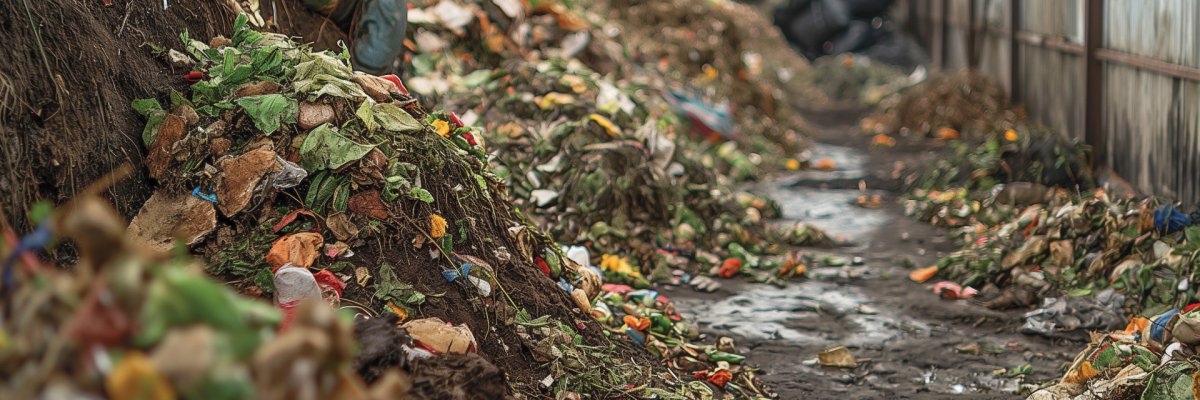
- Do not put organic waste in the general waste bin; instead, place it in the organic waste bin so it can be converted into bio-natural gas and compost. Take yard waste to the recycling centers and yard waste collection sites, where it is accepted free of charge. Alternatively, compost it yourself.
Organic Waste Is Turned Into Bio-Natural Gas
Organic waste from the Fulda district is recycled particularly efficiently. Until the end of 2012, organic waste was composted using a conventional process. While this preserved the nutrients for the natural cycle, the energy contained in the waste remained unused. Since early 2013, the organic waste has been converted into biogas, which is fed directly into the local gas grid.
The Procedure
The waste is delivered to the Biothan facility in Finkenberg, Kleinlüder, where it undergoes fermentation using a special process. The facility is operated by Biothan GmbH, a company within the RhönEnergie Group.
There are two processing methods used on-site: so-called dry fermentation and wet fermentation. The majority of the solid waste processed through dry fermentation consists of the waste from our brown bins. Expired food items are also included. Renewable raw materials such as corn are not used. First, contaminants such as packaging waste are removed, and the material is shredded. It is then placed in huge fermentation tanks, where billions of microbes carry out the fermentation process in an oxygen-free environment.
Wet fermentation follows a similar process to dry fermentation, although the material contains more moisture. Agricultural manure is also utilized in this process.
The biogas produced in this process is used to generate electricity in many facilities. However, the heat generated often cannot be fully utilized. At the Biothan plant, the biogas is therefore refined into bio-natural gas using a special process. To do this, carbon dioxide, water, and sulfur are removed from the gas, and the proportion of combustible methane is increased to over 95 percent.
Even the byproducts of fermentation are put to use: The solid fermentation residues, which contain a wealth of nutrients, are stored, dried, turned several times, and sifted. This produces high-quality compost that is used in agriculture, gardening, and landscaping. The liquid fermentation residues are used in agriculture as a low-odor liquid fertilizer.
Recycling of Residual Waste
Residual waste from the Fulda district is not incinerated, but has been processed into qualified fuels since 2009. As with organic waste, the Fulda district has contractually secured the necessary processing capacity. The residual waste is delivered to highly energy-efficient power plants specifically designed for such fuels, where it is used to generate energy.
The Procedure
Like organic waste, residual waste is first shredded at a special processing plant. The shredded material is then screened and separated into three streams. Recyclable materials, particularly metals, are removed.
The smallest particles, which are less than 25 mm in size (“fine fraction”), are used in anaerobic digesters for biogas production. The larger particles (“oversize,” larger than 120 mm) are used, for example, in cement plants for energy generation.
"Medium-grain" fuel accounts for the largest share, with a calorific value that falls between that of wood and lignite. As a certified fuel with consistent properties, it is used in a power plant specifically designed for such fuels. There, it completely replaces fossil fuels.
At the landfill
The Fulda district is also keeping an eye on waste that was disposed of in the past. Targeted measures are being taken to ensure that emissions generated during the decomposition process are prevented or reduced as much as possible. This is because, in 2005, the disposal of waste in landfills was largely phased out by law in Germany. Since then, waste must either be incinerated or processed for energy generation in special power plants, thereby largely avoiding negative environmental impacts. Only non-combustible mineral waste, such as construction debris, may still be landfilled.
The Procedure
Over long periods of time, waste deposited in the past produces landfill gas, which contains, among other things, methane—a gas that is particularly harmful to the climate. A landfill was operated in Petersberg-Steinau from 1969 to 1982. After it closed, the current Kalbach Waste Management and Energy Center (AEZ) opened. The former facility in Steinau was renovated and equipped with new technology. Using a special process, the landfill gas produced is continuously extracted and passed through a special filter. The filter contains microorganisms that break down methane biologically. At the same time, the landfill body is aerated: The introduced oxygen kills off methane-producing bacteria, and the carbon that is still degradable is metabolized directly into carbon dioxide instead of methane. The degradation processes are accelerated and methane emissions are reduced until, ultimately, the degradable carbon is exhausted. At that point, no further degradation processes occur, nor are there any more climate-damaging methane emissions. In this way, tens of thousands of metric tons of CO equivalents are saved in the medium and long term.
Micro-gas turbines are in use at the Kalbach landfill. This allows methane to be harnessed to generate electricity and heat and converted into carbon dioxide. In addition, the AEZ is currently investigating how landfill gas collection can be optimized.
Both the measures at the former landfill site in Steinau and those at the landfill in Kalbach are funded as part of the federal government’s National Climate Protection Initiative.
Why Recycling Is So Important
Proper waste separation is essential to ensure that waste can be recycled as effectively as possible. This is particularly important for organic waste. The Fulda district’s goal is to connect more properties to the organic waste bin system and to encourage residents to separate their waste more effectively. This is because a great deal of organic waste still ends up in the black trash can. As a result, valuable biomass is lost that could be used to generate energy at the Biothan plant.
However, items that don’t belong there often end up in the organic waste. The county has taken action to address this: Since 2023, garbage trucks have been equipped with a detection system that identifies foreign materials in the organic waste bin. The bin is then not emptied and receives a “red card.” After just about a year, the quality of the organic waste has improved significantly.
The Fulda district also wants to lead by example in waste management: for example, by installing solar panels at waste management facilities and implementing numerous other measures, such as using an electric cargo bike instead of a vehicle at the waste management center, or doing away with mowers—instead, sheep and goats are used to graze on areas that need to be kept clear.
Gift market
The Fulda District is actively committed to waste prevention and to raising awareness and providing education on the topics of conscious consumption and sustainability. Among other initiatives, the Waste Management Department has set up an online giveaway marketplace. The platform offers residents the opportunity to give away or search for used items they no longer need—free of charge and within the region.
Back to School with the "Blue Angel"
Every year, more than 200 million school notebooks are used in Germany. But only one in ten school notebooks is made from recycled paper, even though notebooks and notepads bearing the "Blue Angel" label would be the better choice from an environmental perspective. This is because, in addition to protecting forests, the production of recycled paper can save up to 70 percent water and up to 60 percent energy compared to notebooks made from conventional virgin fiber paper.
For example, did you know that using just 3 sheets of recycled paper saves enough energy to brew an entire pot of coffee? Using 500 sheets saves as much energy as is needed to run a load of laundry in the washing machine.
Anyone can easily contribute to environmental protection here. As the school year begins, the “Blue Angel” eco-label’s recycled paper campaign is launching once again, supported by the Federal Ministry for the Environment, the Federal Environment Agency, the Eco-Label Jury, and RAL GmbH. The Fulda district also wants to support this initiative, raise awareness of environmental protection among even more people, and show just how many ways there are to get actively involved.
At the link below, you'll find a wealth of interesting information about the "Back to School with the Blue Angel" campaign and the benefits of recycled paper. In addition, teachers will find detailed information as well as materials for use in the classroom.
Too Good for the Trash
According to a study, one in eight food items purchased now ends up in the trash. Because food is available anytime and anywhere in our affluent society, we seem to be losing our appreciation for it. Often, food is thrown away that isn’t spoiled at all, but rather appears unappetizing due to minor imperfections or is mistaken for being spoiled because the best-by date has passed.
With about 80 kg of food wasted per resident, this amounts to nearly 7 million metric tons from German households alone. Valuable farmland, water, fertilizer, and other natural resources were wasted in the production, processing, and transportation of this food. However, two-thirds of food waste in private households could be prevented. We throw away food—some of it still in its original packaging—knowing full well that people elsewhere are going hungry.
The Federal Ministry of Agriculture has launched the "Too Good for the Trash" campaign, which the Fulda district also plans to support. In addition to helpful information, the campaign offers many tips on what everyone can do to combat food waste using simple methods.
For food waste that cannot be avoided, the Fulda district has a particularly efficient recycling solution: Organic waste from the organic waste bin is used to generate energy in a digester, and the remaining digestate is turned into valuable compost. In this way, nutrients are also returned to the natural cycle.