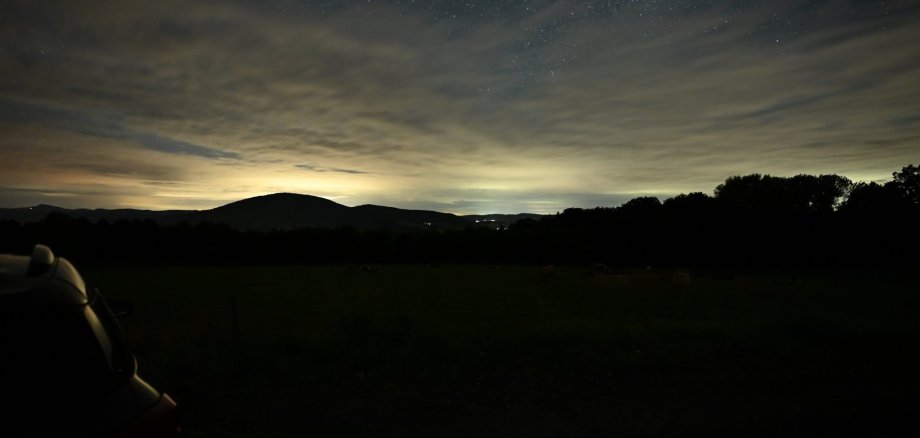
Shortly after the magical twilight ends, the silvery, magically shimmering band of myriads of stars—which on balmy summer nights we used to have to wait until midnight to see—is now visible as early as 8 p.m. And with the start of standard time on October 25, the adorned night sky will be with us as soon as we get off work.
Summer Triangle to the right and left of the galactic plane
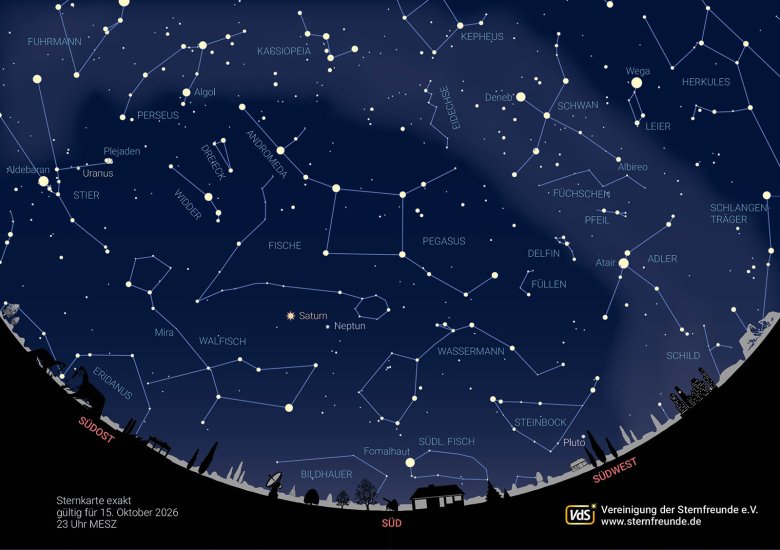
When we look up at the Milky Way above our heads, we can realize that what we’re seeing is the galactic plane of our home galaxy. How wonderful that—in places without light pollution—we can experience this right outside our front doors! Three bright stars stand out in the Milky Way. They form the so-called Summer Triangle, consisting of the brightest stars in the constellations Aquila, Lyra, and Cygnus. The constellation Cygnus is easily recognizable due to its cross-like shape—which represents its outstretched wings. The Swan, it seems, flies across the sky along with the Milky Way. It is Zeus in disguise, on his way to pay a visit to the daughter of the goddess of the night.
If you follow the Milky Way toward the southwestern horizon, you’ll notice a veritable chamber of twinkling stars—it’s the constellation Sagittarius, where the center of our galaxy lies. To the east, the Milky Way leads us to the famous “W” in the sky, Cassiopeia. Here, we’re looking more toward the edge of the Milky Way.
The brightest star and the one farthest from the eye
If you look toward the west, you’ll see a very bright star with a faint orange glow that twinkles like crazy. That’s Arcturus, the brightest star in the northern sky and the last sign of spring. But the planets’ orbits around the Sun are currently aligned in such a way that they make our farewell a little easier. For directly opposite it in the east, you can see a solitary, button-like celestial body that doesn’t twinkle: that’s Saturn, the beautiful ringed planet. In half a year—once Earth has zipped halfway around the Sun—Arcturus will be standing there, heralding the arrival of spring.
If you ever have trouble sleeping, starting at 3 a.m., you can finally see Mars again in the eastern sky, its surface of iron oxide giving it its red color. Hot on its heels is Jupiter, the largest of the planets.
Pegasus, the Square, and Binocular Treasures
Looking eastward from the Swan at its zenith, you’ll see a huge square about halfway along the path. That’s the belly of the winged horse Pegasus, whose father, according to legend, was the sea god Poseidon, and whose mother was the Gorgon Medusa. It now also shines a little east of Pegasus, in the left hand of Perseus, who stands below Cassiopeia like a beautiful string of pearls. If you grab a pair of binoculars with a slightly larger aperture and take a tour from Cygnus to Cassiopeia and from Pegasus to Perseus, all sorts of sparkling gems will reveal themselves, including our neighboring galaxy, Andromeda, 2.5 million light-years away.
Of Autumnal Fireballs and Debris
Fixated on the August shooting stars of the Perseid meteor shower and alienated from the beauty of the night by artificial light, many people fail to realize that shooting stars can be seen all year round. Throughout October, dust particles left behind by Halley’s Comet (the Orionids) and Comet 2P/Encke (the Taurids) treat us to shooting stars as they enter the atmosphere. Although there are only a few per hour—there are, however, some spectacular fireballs among them. The best thing to do is bundle up well and enjoy these eco-friendly fireworks starting at midnight. What’s not at all eco-friendly, however, is what we’ve been seeing more often lately: satellite debris entering Earth’s atmosphere and endangering our ozone layer.
Cheesy Full Moon
Until the new moon on October 10 and the waxing crescent moon on October 17, the nights will be ideal for stargazing. After that, our Moon will increasingly dominate the night sky, and when it rises as a full moon on the 26th around 6 p.m. on the eastern horizon, it should—depending on the amount of dust particles in our atmosphere—shine with a yellowish glow reminiscent of Gouda cheese.
Sleeping People, Skyglow, and Sick Sparrows
Despite its low illuminance of less than 0.3 lx, the full moon is the brightest natural light at night. It even allows us to perceive colors. However, when it shines into our bedrooms, even this low intensity—far below streetlight levels—leads to poorer sleep, as researchers at Charité Berlin have discovered. They explain that light during the rest phase is a stressor and increases levels of the stress hormone cortisol. At the same time, production of the important hormone melatonin is suppressed, which can have a negative effect on metabolism.
The situation is similar in the animal kingdom, as artificial light at night alters their internal clock and inhibits melatonin release, among other things, which disrupts immune regulation. The “Garden Bird Count” campaign has now revealed a drastic decline in house sparrows—the popular sparrows—especially in cities. Avian malaria is suspected to be one of the causes. Studies of tree sparrows have shown that when exposed to artificial light at night, they are less able to cope with infections, remain sick longer, and as a result, can spread viruses and die more quickly.
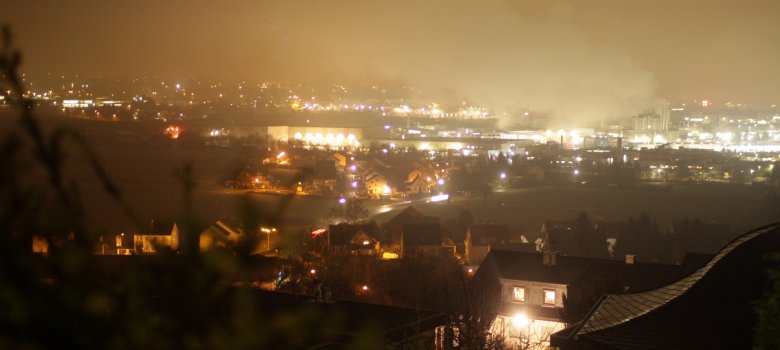
This should concern us, because it is our nighttime, rarely used, constant artificial lighting that—either directly or cumulatively—makes the cloudy city sky as bright as day and shines far beyond the city limits. And, as we know, animals don’t have windows with blinds. So “lights out” isn’t just an issue for stargazers, but also for preserving biodiversity, because as part of the ecosystem, sparrows help with pest control and weed management.