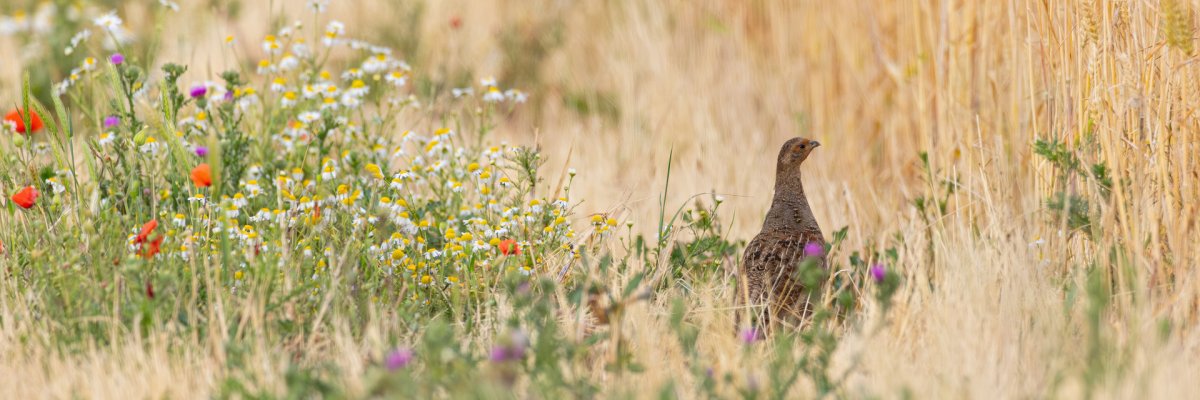
Partridge Conservation in the Fulda District
More than almost any other species, the partridge has literally lost ground: Since the 1980s, its population in Europe has declined by 94 percent. That is set to change—thanks to targeted conservation measures such as those being implemented in the Fulda district since 2021. Numerous farmers are participating in the project, which aims to secure long-term habitats and food sources for this ground-nesting bird. Many other species, such as the skylark, also benefit from the protection of the partridge.
The Partridge
The partridge was once widespread in the Fulda district. In recent decades, however, it has lost a great deal of ground—in the truest sense of the word. While advances in agriculture have nearly doubled yields—for example, in grain—this has been accompanied by a drastic loss of habitat. Added to this is soil sealing: Since the 1980s, more than 6,000 hectares of agricultural land in the Fulda district have been lost to residential and transportation infrastructure or reclassified as forest land. As a result, there has been less and less space for partridges. Nearly all other open-country birds, such as the skylark, the lapwing, and the meadow pipit, share the same fate.
To counteract species loss, particularly in areas used for agriculture, the Hessian Ministry of the Environment launched the special program “Promotion of Key Species in the Open Countryside” in 2018, which is being implemented in nine regions. Representing many other species, the focus is particularly on the common hamster, the corn bunting, and the partridge.
The Project
To counteract species loss, particularly in areas used for agriculture, the Hessian Ministry of the Environment launched the special program “Promotion of Key Species in the Open Countryside” in 2018, which is being implemented in nine regions. Representing many other species, the focus is particularly on the common hamster, the corn bunting, and the partridge.
The Fulda district has also been participating in the project since 2021. The most important partners are the farmers, who are working with the Fulda District’s Lower Nature Conservation Authority to implement targeted measures to protect this field-dwelling species. Currently, there are 40 farms participating, and nine more are expected to join the project in 2026.
Thanks to positive population trends, the partridge conservation project has proven to be very successful in recent years. As a result, the conservation project has been extended beyond December 31, 2026, through December 31, 2031.
The Measures
The focus is on “better living.” The goal is to create habitats where the partridge can nest, forage for food with its chicks, and find sufficient cover.
For example, farmers establish open, structurally rich partridge habitat areas using a special seed mixture (the Göttingen mixture), which serve as refuges for several years. They leave part of the grain harvest standing to provide food, or they plant crops in wide rows rather than in a dense pattern so that partridges can find not only cover but also sufficient open ground and insects.
Farmers will be compensated for implementing the relevant measures. Applications for these measures are not tied to the HALM2 application deadline and may be submitted independently of it.
Maintenance activities in the cultural landscape, such as mowing and mulching roadside verges and embankments and maintaining hedgerows, can also be tailored to the needs of the partridge.
Farmers who decide to establish such areas—and, where appropriate, also adapt their management practices in the cultural landscape—make an enormous contribution to the conservation and enhancement of biodiversity in the Fulda district.
Here's How Farmers Can Help
Farmers interested in joining the project and implementing measures to protect the partridge can contact the local nature conservation authority. The five-year agreements are entered into through the HALM-2 program.
Here's How Citizens Can Help
The answer is simple: When hiking or walking, stay on the trails! Between April 1 and August 15, it’s best to stick exclusively to gravel or paved paths, since meadow paths are also important breeding and living habitats for all wildlife. Dogs should also stay on the trails. Spring is the time when wild animals raise their young.
In general, you should behave calmly and thoughtfully when out in nature. Noise, loud music, or sudden movements can startle ground-nesting birds such as partridges, lapwings, or skylarks—and, in general, all wild animals—and cause them to panic. If they then abandon their nests, the eggs and chicks will become chilled, grow weak, and die.
Picnic? No problem! You'll find benches or seating areas in many places. However, be sure to pack up your trash and any leftover food.
Interested citizens who would like to volunteer as mappers through Proengagieren can contact the Lower Nature Conservation Authority.
"Göttingen Mix" Seed Blend
% (by weight) Name Scientific name 17 Flax Linum usitatissimum 15 Sunflower Helianthus annuus 14 Buckwheat Fagopyrum esculentum 8 Forest Perennial Rye Secale multicaule* 7 Alfalfa Medicago sativa* 7 Phacelia Phaceiia tanacetifolia 7 Oil Radish Raphanus sativus 5 Cultivated Mallow Maha sylvestris ssp. mauritiana* 5 Oats Avena sativa 5 Narrow-leaved Lupine Lupinus angustifolius* 2 Yellow Sweet Clover Melilotus officinalis* 2 Summer vetch Vicia sativa 2 Pistillate millet Setaria italica 1 Yellow mustard Sinapis alba 1 Alexandrian clover Trigonella foenum-graecum 1 Alexandrian clover Trifolium alexandrinum 0,5 Stalk Cabbage Brassica oleracea* 0,5 Turnips Brassica rapa * multi-year or biennial