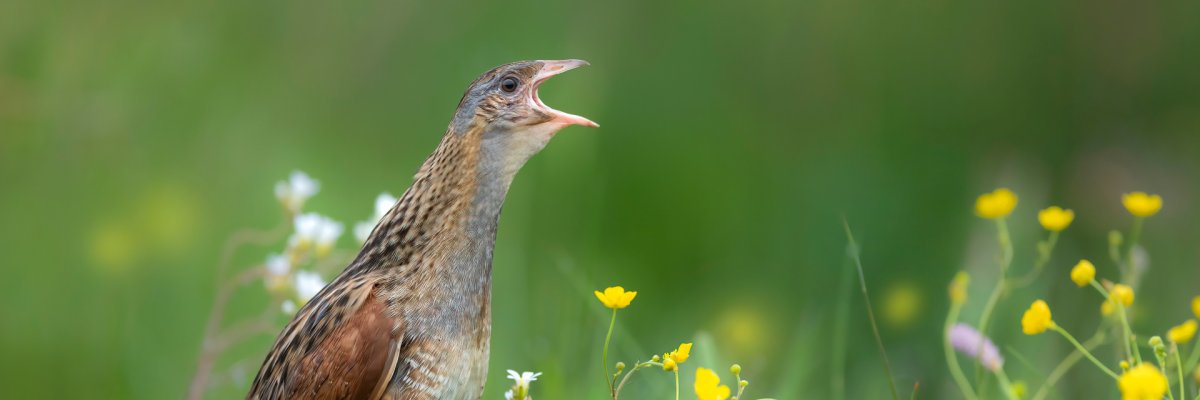
Working to Protect the Corncrake
Every year, as spring arrives and the breeding season begins, the mapping season gets underway in the Fulda district. The survey identifies the locations where rare or protected species breed and documents their numbers. This allows for the targeted planning of conservation measures.
The same is true for the corncrake (Crex crex). It is a meadow-nesting bird and is threatened with extinction throughout Germany and Hesse. In the Rhön, it is still found regularly—thanks to conservation measures. In 2023, for example, there were 20 corncrake territories in the Hessian Rhön. Across all of Hesse, there were 27 in total. This means that nearly three-quarters of all Hesse’s corncrakes bred in the Hochrhön, which highlights the great importance of this habitat for this ground-nesting bird and many other species.
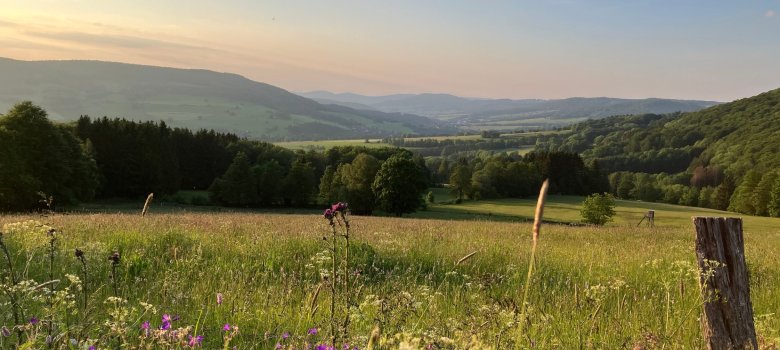
In 2025, about half of all corncrakes in the state were found in the Hochrhön region. The Hessian portion of the Rhön UNESCO Biosphere Reserve is therefore by far the largest—and indeed the only—breeding area in the state used by this species every year.
It is only through the cooperation of all those involved that it is possible to preserve such rare birds as the corncrake in the Fulda district.
What are the protective measures?
The Fulda District’s Nature and Landscape Department works with farmers to plan when areas within the breeding grounds will be mowed or grazed. Certain areas are left untouched, or parts of the land are not fully utilized, in order to protect the bird’s ground-nesting broods. Compensation for crop losses is provided from nature conservation funds.
How can the public help the corncrake and other ground-nesting birds?
During the breeding and nesting season from March through September, please stay on the designated trails and keep dogs on a leash. If you hear a corncrake, please feel free to let us know.
Where does the corncrake spend the winter?
The corncrake spends most of the winter in Africa, south of the equator.
When will the corncrake (return) to the Rhön?
He usually returns to Hesse between mid-May and mid-June. The males arrive first and select suitable breeding grounds.
What are typical habitats?
They prefer open meadows with sufficiently tall vegetation, which they need for cover. From here, the males attract the females flying overhead with their loud calls, which often ring out for hours at night. It is thanks to this distinctive call that the corncrake earned its common name, “meadow craker,” as well as its scientific name, Crex crex.
How many eggs does the corncrake lay?
After mating, the female lays 7 to 12 eggs and incubates them. The chicks, which are jet-black at first, leave the nest very quickly and are guided by the female until they can fend for themselves.
What does the corncrake eat?
The corncrake feeds primarily on insects and other small invertebrates. Seeds and green plant parts are also part of its diet. To ensure that the young birds can grow up successfully, it is important that the land is no longer cultivated once a male has settled in the area. This period of rest should last until late August or early September.