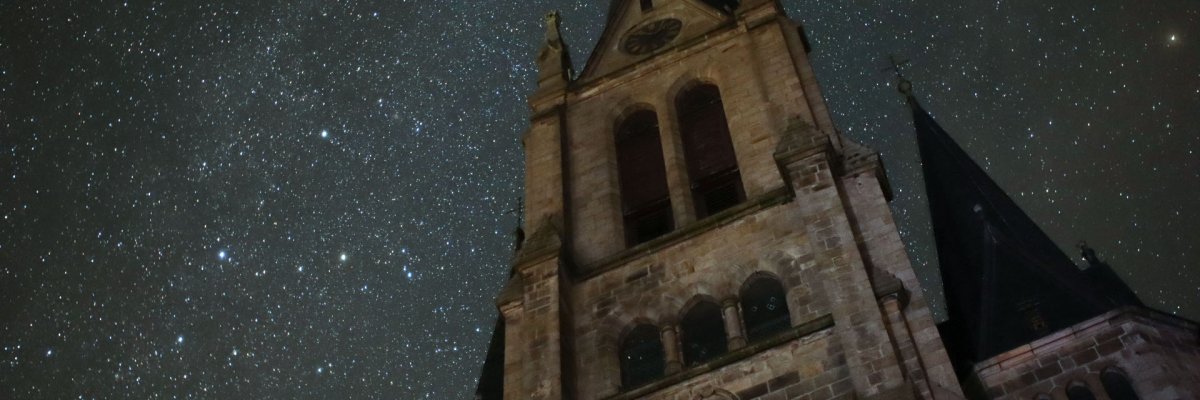
Rhön Star Park
Numerous municipalities in the Fulda district are committed to protecting the night sky. In the Rhön Star Park, the goal is to preserve natural darkness. Light pollution—that is, the brightening of the night sky caused by widely scattered light—is to be minimized as much as possible. This is achieved through appropriate, considerate lighting.
These efforts not only protect biodiversity, the climate, and public health; they are also intended to preserve the Rhön’s unique starry sky for the long term. Thanks to the relatively low level of light pollution, thousands of stars, shooting stars, and other celestial phenomena can be seen here.
What is the Star Park?
The title “Star Park” is awarded by the International Dark Sky Association (IDA) to areas with a night sky landscape that is particularly worthy of protection and remains nearly pristine. The Rhön UNESCO Biosphere Reserve, located in the tri-state region of Bavaria, Hesse, and Thuringia, was recognized as an International Dark Sky Park by the IDA in August 2014 following an application by ARGE Rhön. With this designation, the region voluntarily commits to reducing light pollution as much as possible. The measures implemented in the Star Park are documented annually and re-evaluated by the IDA.
The designation as a Star Park has also created potential for adding value to the region’s tourism sector. The primary goal here—as with all experiential offerings in the Rhön UNESCO Biosphere Reserve—is to reconcile tourism and nature conservation through efficient visitor management.
Where is the Star Park located?
The Rhön Star Park is not an “adventure park” with an entrance and an exit. Essentially, it extends across the territory of the UNESCO Rhön Biosphere Reserve in Hesse, Bavaria, and Thuringia. However, municipalities outside the Rhön have also signed the Rhön Star Park’s lighting guidelines and are committed to protecting the night sky.
The "Starlight Park" municipalities in the Fulda district are:
- Dipperz
- Ebersburg
- Ehrenberg
- Eichenzell
- Gersfeld
- Hilders
- Hofbieber
- Hünfeld
- Künzell (as a municipality outside the biosphere reserve)
- Neuhof (as a municipality outside the biosphere reserve)
- Petersberg (as a municipality outside the biosphere reserve)
- Poppenhausen
What's being done?
The Star Park municipalities have signed a special lighting guideline and have thus voluntarily committed to upgrading their lighting systems to be more environmentally friendly. They are working closely with the Star Park Coordination Office in the Fulda district and with local energy providers.
In accordance with the Star Park guidelines, the lighting systems meet four basic criteria: targeted light distribution, appropriate light levels, demand-based lighting, and warm light colors.
Proper Lighting—How Does It Work?
There are many ways to reduce light pollution. Individuals, businesses, and local governments can use the following questions as a guide:
- Is artificial outdoor lighting really necessary?
- How long does the lighting need to stay on?
- In which areas is lighting needed (directing light onto the usable area)?
- Which light source (bulb) is suitable?
When choosing a light source, look for a warm light color of up to 3,000 Kelvin—or even better, up to 2,700 Kelvin. Also consider the light output: 200–300 lumens are sufficient for private homes, while 500 to a maximum of 800 lumens are sufficient for larger (yard) areas.
Existing lighting systems can also be improved through retrofitting:
- Light Distribution: Can the light fixture be adjusted retroactively so that it shines only on the usable area?
- Light Color: Using a filter film can make harsh light appear warmer.
- Scope and Duration of Lighting: To what extent—that is, how much—light is used?
- Smart Lighting: Are properly configured motion sensors—or, better yet, timers—being used to control the lights based on need?
Experience the Starry Sky
Tourism in the Rhön also benefits from the designation as a Star Park. The goal is to combine hands-on experiences with raising awareness: During guided tours led by certified starguides, locals and visitors alike are made aware of the importance of protecting the night sky. There are also numerous other offerings, such as the Rhön Sky Viewing Spots.
An important note when experiencing the dark Rhön night: The night should remain dark! And the animals should not be disturbed. There are therefore designated areas for stargazing. Please stay on the marked trails and avoid light and noise.